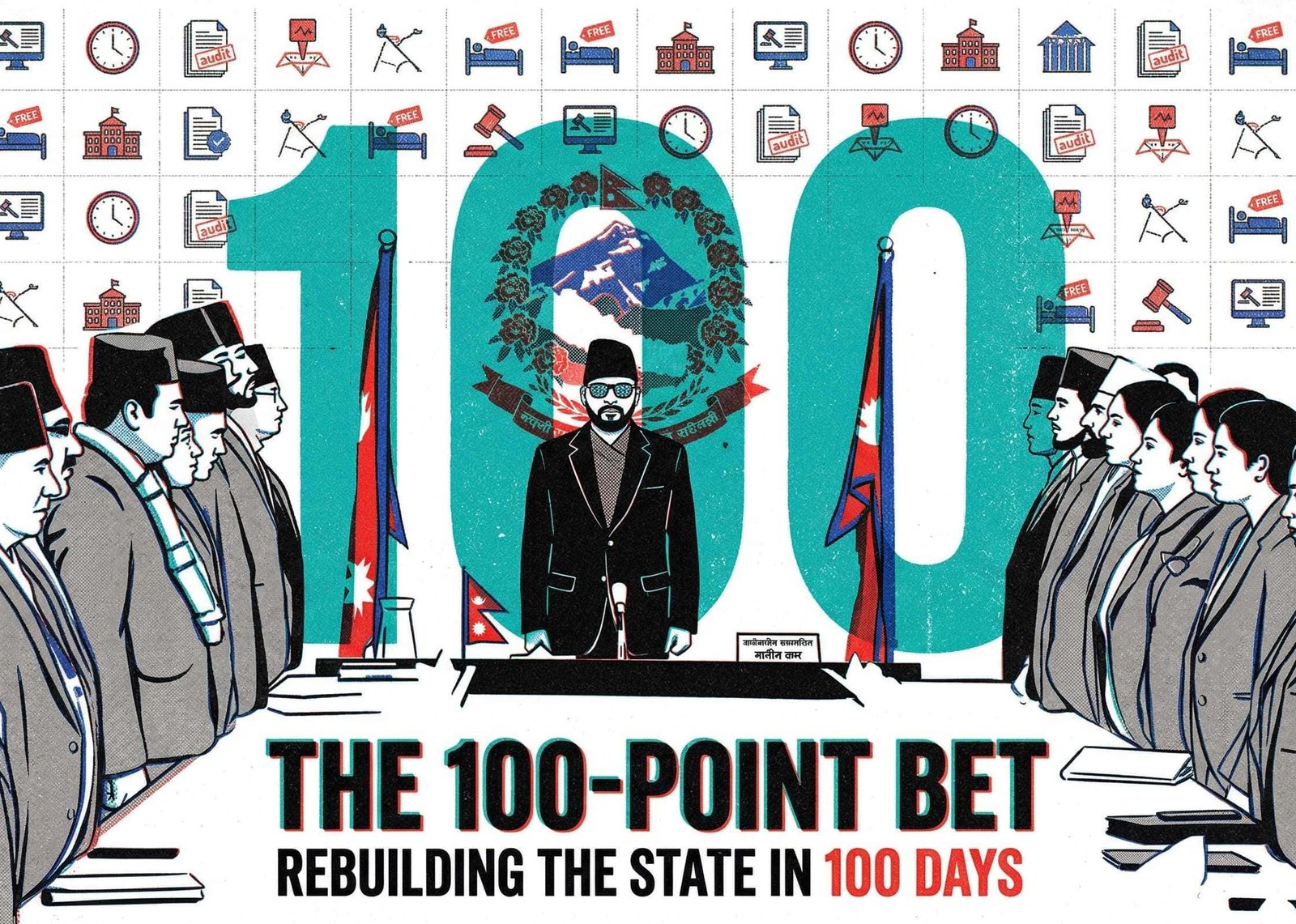
Two days ago, the Council of Ministers approved a document that, on paper, is one of the most aggressive governance reform agendas any South Asian government has attempted in a single sitting. One hundred action items. Deadlines ranging from 24 hours to 1,000 days. A scope that covers everything from banning betting apps to investigating the personal wealth of every major politician since 1991.
I have read the full Nepali text, all 19 pages. What follows is an attempt to explain what it means in plain language, what changes if these plans actually land, and where the obvious fault lines are.
Let me be upfront: I am not writing this to celebrate or attack the Rastriya Swatantra Party. I am writing it because this document deserves serious reading and nobody seems to be doing that. Most coverage so far has been either cheerleading or dismissal. Neither is useful.
The 24-Hour Promise and the 1,000-Day Problem
The shortest deadline in the document is 24 hours. That is how long the Ministry of Communication and IT has to ban betting apps and related websites. It is a crowd pleaser and technically feasible. ISPs can block domains fast. Whether it actually stops gambling is a different question. VPNs exist. New domains cost nothing. But as a signal of intent, it works.
The longest deadline is 1,000 days to resolve Nepal’s landless squatter problem. That one is real. It involves household surveys, GIS mapping, eligibility criteria (cut-off dates, income thresholds, other property ownership checks), phased land allocation, and alternative urban housing through land pooling or apartment models. A public dashboard would track the whole thing.
If it worked, it would settle a problem that has festered since the land reform failures of the 1960s. Millions of people live on land they do not legally own. Political parties have used them as vote banks for decades, promising titles that never come.
Why it might not work
Every government since 2007 has promised to solve the squatter issue. The problem is not data collection. It is political will. Powerful people own the land that squatters occupy. Others profit from keeping the registry messy. And “clear eligibility criteria” is doing a lot of heavy lifting in that sentence. Who decides the cut-off date? What happens to people who arrived one day after it?
Shrinking the Government
Point 9 says the number of federal ministries will be reduced to 17 within 30 days. A “Restructuring Management Secretariat” at the Prime Minister’s office will handle the transition, including managing existing promotions so that service delivery is not disrupted.
Nepal currently has more than 25 ministries. Many exist because coalition governments handed out portfolios as political favors. If this actually happens, it would be a direct attack on the patronage system that has defined Nepali politics since 1990.
Point 12 goes further. It says party-affiliated trade unions in public administration will be abolished. All civil servants, teachers, and professors must work free from any affiliation with any political party. Violations get strict departmental action. The Federal Civil Service Bill is to be drafted within 45 days.
If the trade union abolition sticks, it would be the most significant structural change to Nepal’s civil service since the introduction of multiparty democracy.
Here is the problem. Those trade unions are not just labor organizations. They are the nervous system of party power inside the bureaucracy. They control transfers, postings, and promotions. Every major party has one. Abolishing them on paper is easy. Actually dismantling them requires either total political commitment from every coalition partner or a government so popular that no one dares resist. The RSP has a strong mandate, but “strong mandate” and “able to restructure the entire civil service in 45 days” are not the same thing.
The Property Investigation
This is the part that will make people nervous.
Point 43 calls for an empowered Property Investigation Committee under the Prime Minister’s office within 15 days. It includes experts in law, finance, revenue, and investigation. In the first phase, it investigates the assets of every major political officeholder and senior official who served from 2006 to the present. Phase two goes back to 1991.
That is 35 years of political leadership. Every prime minister, every finance minister, every chief secretary. The committee gets powers to collect documents, analyze records, and make recommendations for action through relevant agencies.
If this were carried out honestly and completely, it would be the most sweeping anti-corruption exercise in Nepali history. The scale is comparable to what South Korea attempted with its post-democratization asset investigations, though Korea had a much stronger institutional base to work from.
The catch
Nepal has formed investigation commissions before. Dozens of them. Their reports sit in filing cabinets. Point 8 in this same document acknowledges this exact problem. The plan’s answer is that commission recommendations will now actually be implemented within 30 days. But that is a promise about promises. And the people being investigated are the same people who would need to cooperate with the process. Many still hold power in provincial governments, party structures, and the judiciary.
Digital Everything
If you only read one section of this document, read section D. It lays out a plan to digitize nearly every interaction between citizens and the state.
The basics: a National Integrated Digital Governance Platform (Point 36), auto-fill so you only give the government your information once (Point 29), an appointment system so you pick your own time to visit offices (Point 32), file tracking with automatic alerts to supervisors when papers sit too long on someone’s desk (Point 34), and certificate downloads through the Nagarik App within 15 days (Point 35).
The Nagarik App detail is interesting. The plan says it must not store data centrally. Information stays on the user’s phone and fills forms locally. That is a privacy-by-design approach that most developed countries have not implemented.
The bigger structural play is Point 39: abolish the existing IT Department and create an IT and e-Governance Office directly under the Prime Minister’s office within three months. This acknowledges what everyone already knows. Nepal’s digital infrastructure is fragmented across agencies with no interoperability, no shared standards, and no one in charge.
Point 33 wants to replace certificate-based digital signatures with NID-based biometric or OTP authentication. That is essentially building Nepal’s version of India’s Aadhaar authentication layer, but with the added step of strengthening the National ID department physically and organizationally first.
The reality check
Nepal tried e-governance before. The country has been talking about GIOMS (Government Integrated Office Management System) for years. Most offices either do not use it or use it alongside paper systems, creating more work rather than less. The problem has never been the technology. It has been adoption, training, internet connectivity in rural areas, and the fact that many officials prefer opacity because it gives them discretionary power. A file tracking system with alerts is useless if the supervisor receiving the alert is the one causing the delay.
Health: Free Beds, Affordable Pharmacies, and the Burn Ward Gap
Point 85 is a package. The headline item: both government and private hospitals must make at least 10% of their beds free for destitute and unattended patients. This is not a new rule. It has been on the books. What is new is the enforcement mechanism: a “Free Health Portal” deployed within 30 days for real time monitoring of which beds are free, who is using them, and where.
If that portal works and the data is public, it changes the game. Right now, private hospitals routinely claim all beds are occupied when poor patients show up. Real time transparency makes that harder to get away with.
“Sulabh Pharmacy” is the other big move. Government hospitals and major health institutions would stock essential medicines under generic names at minimum prices, with private sector cooperation for supply chain management. Nationwide rollout in phases within 100 days.
The burn ward provision (Point 85e) is quieter but matters a lot. Nepal has almost no provincial-level burn treatment capacity. Most burn patients have to be transported to Kathmandu, and many die on the way or cannot afford the trip. Opening burn wards in most hospitals within 30 days is aggressive. Actually equipping them and staffing them with trained personnel will take longer. But starting the process has real value.
Air ambulance standby for far-western, central, and eastern hill regions (Point 85f) addresses the same problem from the other end. If you cannot build hospitals everywhere fast enough, you need to be able to move patients.
Delivery Unit, KPIs, and Whether Any of This Gets Tracked
Point 2 says every ministry must produce a top-10 task list with timelines, responsible officers, and performance indicators within 7 days. Point 64 establishes a “PM Delivery Unit” under the Prime Minister’s office with a central dashboard for KPIs, ministry performance tracking, and problem-solving mechanisms.
This is modeled on Tony Blair’s Prime Minister’s Delivery Unit from the early 2000s, which the UK used to push through reforms in health and education. Malaysia and several African countries copied versions of it.
The model works when three conditions hold: the PM personally reviews the dashboard regularly, there are consequences for missing targets, and the unit has enough bureaucratic muscle to unblock problems across ministries. In the UK, Michael Barber ran the unit and had direct access to Blair. It worked because Blair backed him up when departments resisted.
In Nepal, the question is whether this unit will have teeth or become another coordination body that holds meetings and writes reports. The document says it will have “problem-solving and obstacle-removal mechanisms.” That is vague enough to mean anything.
Energy: The Export Strategy Nobody Talks About
Nepal generates more electricity than it uses domestically for parts of the year, then imports during the dry season. The plan calls for an energy export strategy within one month, decisions on all pending Power Purchase Agreements within 180 days, and a focus on exporting during high value evening peak hours.
If Nepal could reliably sell surplus hydropower to India and Bangladesh during their evening demand peaks, the revenue implications are significant. This is not wishful thinking. The infrastructure for cross-border transmission exists. The constraint has been political and regulatory, not technical.
Point 74d calls for a “structural reform roadmap” for the Nepal Electricity Authority (NEA). NEA has been a financial black hole for decades. It loses money on domestic distribution, has opaque procurement practices, and resists competition. Reforming it is probably harder than any other single item on this list.
The diaspora angle
Point 74e mentions “diaspora investment” as part of multi-dimensional financing for the energy sector. This is new language. Nepal’s diaspora remits over $10 billion annually. If even a fraction were channeled into hydropower bonds or investment vehicles, it could change how projects get financed. But diaspora investment requires trust in institutions, transparent returns, and protections that Nepal’s financial system does not yet offer.
The Gen-Z Reckoning
The document keeps returning to the Gen-Z movement of Bhadra 23 and 24, 2082. Multiple points address it from different angles. Point 6 promises a coordinated restoration package for affected families within 100 days. Point 7 forms a high-level investigation committee within one week. Point 63 promises concessional packages for businesses damaged during the movement. Points 69a through 69e lay out a whole private sector protection framework.
There is something uncomfortable about how much of the document is oriented around this event. It suggests the government sees its legitimacy as tied to how it handles the aftermath. That is probably accurate. The movement is what broke the previous government. Failing to deliver justice and restoration could break this one too.
The investigation committee (Point 7) will matter most. If it is genuinely independent and its findings lead to prosecution, it sets a precedent. If it produces a report that gets filed away, it confirms the pattern that Point 8 is supposed to break.
Women’s Safety and the Blue Bus
Point 97: free “Blue Bus” services in all seven provinces for safe women’s mobility. At least 25 buses operating within 100 days.
Point 98: CCTV and dashcams in all public transport vehicles, SOS buttons mandatory in ride-sharing apps, immediate alerts to police. Done within 30 days.
The Blue Bus is a visible, symbolic commitment. 25 buses across seven provinces is not going to solve urban transport, but it creates a proof of concept. If the buses run on time, are clean, and are actually safe, they become a political asset that is hard for any future government to cancel.
The SOS button mandate for ride-sharing apps is more immediately practical. Nepal’s ride-sharing market is growing fast, and incidents of harassment go largely unreported because there is no easy mechanism. A button that alerts police directly changes the calculus for both riders and drivers.
Investment Climate and the Startup Promise
Point 56 promises business registration within two days through a “Startup Fast Track” system. Point 58 integrates business registration, tax registration, and bank account opening into a single digital platform within 45 days. Point 66 allows industries up to NPR 250 million to register through the Cottage and Small Industry Office only, and abolishes registration fees.
If you have ever tried to start a business in Nepal, you know the current process takes weeks, sometimes months, involves multiple offices, and usually requires “facilitation fees” at each stop. A two-day registration system would be transformative. It would also put a lot of intermediaries out of work, and those intermediaries have relationships with the officials who would need to implement the new system.
The One Door Approval System under the Investment Board Nepal (Point 55) addresses larger investments. The idea is that domestic and foreign investors deal with a single entity instead of bouncing between agencies. Nepal has tried this before. The previous one-stop shop became a one-more-stop shop because agencies refused to delegate authority. The plan says it will be “established within one month and operationalized within one month.” Two months from paper to function. I would bet on four to six if things go well.
Agriculture: Finally Talking About Farmers
Point 90a introduces minimum support prices for major food crops within 30 days. Point 90b mandates that agricultural produce purchases must be paid within 25 days, with interest for late payment. It also calls for a National Agricultural Market Information System providing daily prices via SMS, weekly haat bazaars in every municipality, and cold storage centers through public-private partnership in every district, with feasibility studies starting within 10 days.
Nepal’s farmers get crushed every harvest season. Middlemen control prices. Payment comes late or not at all. Cold storage barely exists, so perishable goods rot before reaching markets. If minimum support prices and mandatory payment timelines were enforced, farmer income would stabilize and some of the pressure driving rural-to-urban migration would ease.
The cold storage program is the most practical item in the agriculture section. Nepal loses an estimated 20-30% of its vegetable and fruit production to spoilage. One cold storage center per municipality, if built, would have a direct and measurable impact on food waste and farmer income. The question is financing. Public-private partnership sounds good in a document. Getting private capital to invest in cold chain infrastructure in remote municipalities requires either guarantees or returns that the current system does not provide.
What I Keep Coming Back To
I have been reading government reform documents in Nepal for years. This one is different in a few ways.
First, the deadlines are specific. Not “within the next fiscal year.” Seven days. Fifteen days. Thirty days. That is either confidence or recklessness, depending on how the first month goes.
Second, the scope is almost suspiciously complete. It touches revenue, health, education, agriculture, land, energy, digital governance, anti-corruption, investment, tourism, women’s safety, cooperative deposits, and customs reform. There is no major policy area left out. That can mean the government has an unusually coherent vision. It can also mean the document was written to have something for everyone, which makes prioritization impossible.
Third, the enforcement mechanism is the weakest link. The PM Delivery Unit, the monthly reporting, the dashboards. These are good ideas. But Nepal’s problem has never been planning. It has been execution. The country has a world-class ability to produce plans and a dismal track record of implementing them.
Nepal’s problem has never been planning. It has been execution. The country produces plans with the best of them. It implements them like no one is watching. Because usually, no one is.
The property investigation will be the test. If politicians from 1991 to today actually have their assets scrutinized and face consequences, everything else becomes more credible. If it stalls or gets quietly shelved, the rest of the list is just another list.
The cooperative deposit return (Point 99) will be the emotional test. Thousands of small savers lost their money. They are angry. They vote. Getting their deposits back within 100 days would generate more goodwill than any infrastructure project. Failing to do so, after putting it in writing, would be devastating.
I do not know if this government can deliver on even half of this. What I know is that the document exists, the deadlines are public, and the promises are specific enough to be checked. That is more than we have had before. Whether it is enough depends on what happens in the next seven days, when those first ministry action plans are due.
I will be watching.
The author is an independent journalist based in Nepal who covers governance and public policy. This analysis is based on the full Nepali text of the 100-Point Action Plan approved on 2082 Chaitra 13. Contact: through secure channels only.